
Direct Access Supports Inclusive Wayfinding at The Harris Through Installation of New Tactile Maps
The Harris has enhanced its visitor experience with the installation of new tactile wayfinding maps designed to improve independent navigation for blind and sight-impaired visitors.
Delivered as part of the Harris Your Place project, the initiative reflects a shared commitment to embedding accessibility into the design, planning, and long-term operation of the building. Working in close collaboration with international accessibility consultants, Direct Access have supported the development of inclusive navigation solutions throughout the building.
The newly installed tactile map board, located at The Flag Market entrance, features raised elements and Braille text alongside a clear, colour-coded floor plan of the ground floor.
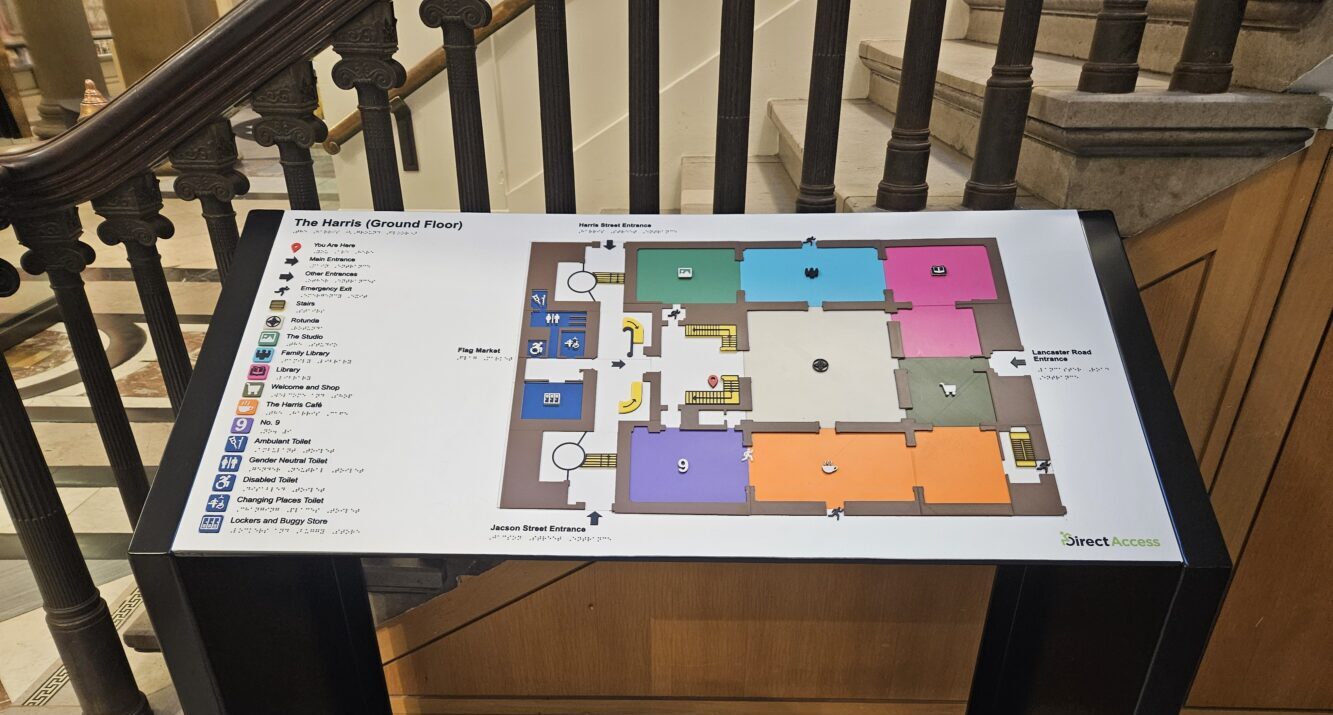
In addition, swell paper maps have been provided for the upper floors to support continued wayfinding throughout the building.
Designed primarily to support blind and sight-impaired visitors, the maps are universally usable. Including intuitive icons to denote room functions, such as a magnifying glass for study areas, a book for library spaces, and framed images for gallery spaces.
Projects such as this demonstrate what can be achieved when accessibility is integrated as a core design principle rather than applied retrospectively. The result is a more intuitive, better-performing environment that supports independent use for a wider range of visitors. By prioritising inclusive design from the outset, The Harris and Direct Access have created a more welcoming, intuitive and equitable experience for all visitors.
Peter Brassington, Managing Director of Direct Access, said: “Tactile maps need to do more than replicate a floor plan; they need to communicate a space in a way that is clear, usable, and meaningful through touch.
At The Harris, we focused on simplifying information and prioritising what visitors actually need to navigate independently, ensuring the maps support real journeys through the building rather than just describing it. This reflects Direct Access’ approach to accessible materials: focusing on clarity, usability, and real-world application.
While designed to support blind and sight-impaired visitors, this clarity also benefits a much wider audience including children, tourists who may not speak English, and anyone who finds visual information overwhelming or difficult to interpret.”

