
Discover Our Favourites
Jenny
Object Number: Perseus with the Head of Medusa
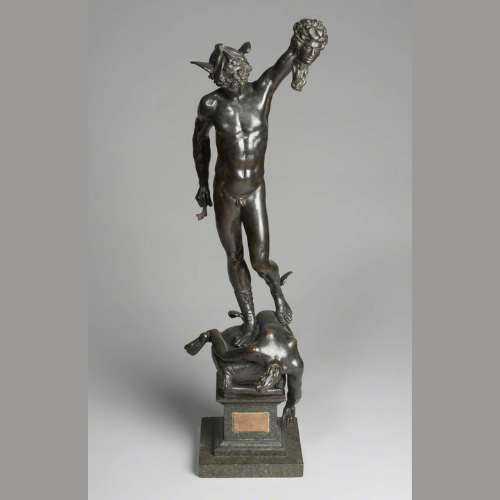
For me, one of the highlights within The Harris collection is Benvenuto Cellini’s Bronze statue Perseus with the Head of Medusa, located on the Second Floor. The sculpture depicts a gruesome scene from Greek Mythology: hero Perseus holding aloft the severed head of the fearsome monster Medusa, as he stands triumphant on the crumpled remains of her body.
As the original story goes, Medusa started off as a beautiful Priestess of Athena. She was relentless pursued by Poseidon, so to try and escape his advances she sought shelter in Athena’s Temple. The temple walls did nothing to shield her from the desire of a powerful God and this act angered Athena greatly. She viewed the deed as a defilement of her Temple and pinned the blame on Medusa, transforming her into a monstrous gorgon with snakes for hair and a gaze that would instantly turn people to stone. The story of the myth then leads us to the image depicted within the statue, as Perseus is sent on an impossible quest to slay the ‘monster’ and bring back her head as proof of completion.
In my opinion, the myth of Medusa exists as one of the most important Greek Myths when revisited with a modern, feminist lens. During my Master’s Degree, I modernised the classical story to draw an emphasis on the way Medusa is the victim in the myth. I believe Cellini’s statue alludes in several ways to the problematic nature of the supposedly heroic deed. Firstly, the downturned angle of Perseus’ head; whilst this could be interpreted as his avoiding the gaze of the gorgon, I would like to believe that he is showing exhaustion and remorse for the murder he has committed. The shard of the sword he desperately clutches in his right hand clearly reflects the intense battle and suggests that once against Medusa had the strength to fight against her impending fate.
At the bottom of the statue, underneath Perseus’ feet, Medusa’s broken body is slumped over a plinth. For the second time, her body has been wickedly defiled by a man, and I interpret that the inclusion of this plinth represents how the murder of Medusa catapulted Perseus to fame within Greek Mythology. To the general population, the name Medusa most likely conjures a mental image of a gruesome monster. In contrast, Perseus is known as a brave hero who slew a monstrous beast. The reality of the dynamic between the two is clear and with the feminist lens, we see Medusa clearly as a victim of horrific circumstances.
The statue is located within the Greek Mythology themed case on the second floor. Some of the chosen Harris collection pieces with this case are themed around a feminist perspective that was sorely missing within the original epic poetry of the likes of Ovid and Homer.
Janet
Object Number: The Veiled Bride
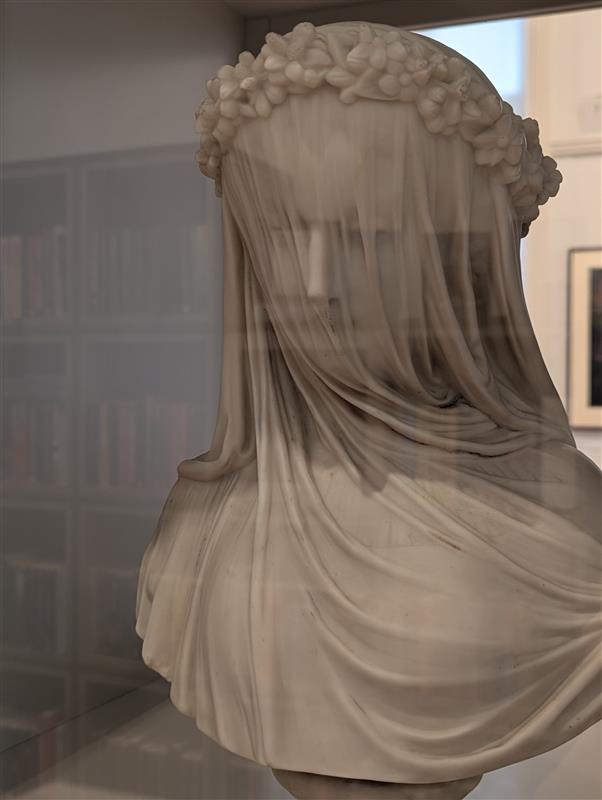
The Veiled Bride, currently on display in No. 9, ticks a couple of boxes with me. It is a beautiful sculpture of a young woman on her wedding day, about to meet the man she is to marry and who will gently raise the veil at the altar. However, for someone like me who enjoys tales of the gothic and Victorian sensation novels by authors such as Wilkie Collins, The Veiled Bride also exudes an air of mystery.
A covered face and eyes downcast, averted from the viewer; is there more to her story, with the veil not symbolising modesty but secrets about to be uncovered, or does the veil obscure her eyes from seeing unexpected danger? Will the man in her life be a cad, or does her beauty hide a villainous heart?
Laura
Object Number: Special Collections
My favourite room in The Harris has to be Special Collections.
Whenever I walk into the space, there’s an immediate sense of calm. I notice it more prominently after I’ve been in the Wallace and Gromit exhibition, which is bright and filled with sounds of nostalgia, from the film clips on the tv screens to the visitors discussing their fondest memories of the series. The atmosphere is alive, and you can hear the unbridled joy in every area of the exhibition.
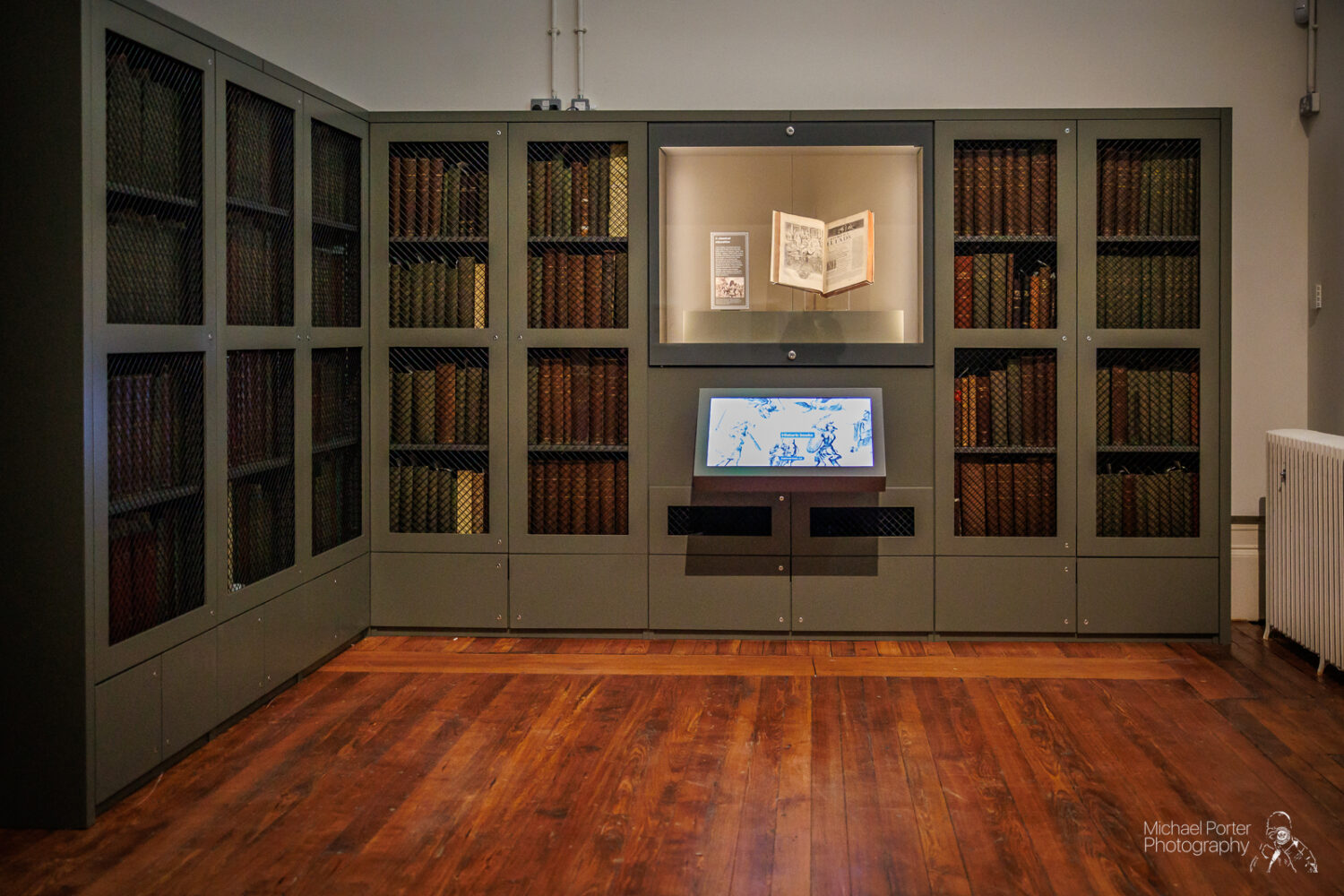
So walking through the doors that lead into Special Collections is like stepping into a vacuum. Noises fade (other than the occasional bird song, and pencils fervently scribbling via overhead projections) and the lights dim into something softer. The temperature also changes, but it isn’t unpleasant; it’s subtly cooler than in the Aardman exhibition, but it’s not quite cold.
On a personal level, it offers me a different kind of nostalgia than I find in the Aardman exhibition; when trying to explain why Special Collections is my favourite room, my mind conjured a memory of lining up outside church when I was still in primary school, and knowing that as soon as we walked through the doors, there would be an air of quiet reverence that we didn’t want to break.
For whatever reason, being in the Special Collection room creates a familiar sensation in me, albeit to a lesser degree. No matter how many times I walk through the space, I feel as though I can slow down, take a breath, and gather myself. Even though I’m unable to touch the books, I find it cathartic to share the space with them.
Reaching the end of the room and stepping into the light of the art gallery is like re-entering the Harris from somewhere else, emerging from a liminal space. There’s still an air of tranquillity that’s inherent in gallery spaces, a natural hush that seems to fall over people when they’re surrounded by art. But I think some of it is carried over from Special Collections; it’s the way our regular volume seems so much louder after whispering, so we keep our voices to a murmur, like a compromise that no one inherently asked us to make.
Since we opened, I’ve heard a few people comment that they wish the room had been used differently, or that they don’t understand the purpose of books which are locked away with their spines partially obscured by metal mesh cages; the most common refrain that I’ve heard with regards to that room is ‘books are intended to be read’.
But when I hear that, I think that toys are supposed to be played with, cups are to be drunk from, hairbrushes are made to be used. But these are items found behind glass in museums across the world because we understand that they need to be preserved and protected, that they’re still important and worth appreciating even if we can’t touch them. I feel the same about the books in the Special Collections room; the fact that I can’t touch them makes me appreciate them all the more.
Jenny
Object Number: Southwell Minster from the North West, by J.M.W. Turner (circa 1793)
What should visitors not miss when they visit?
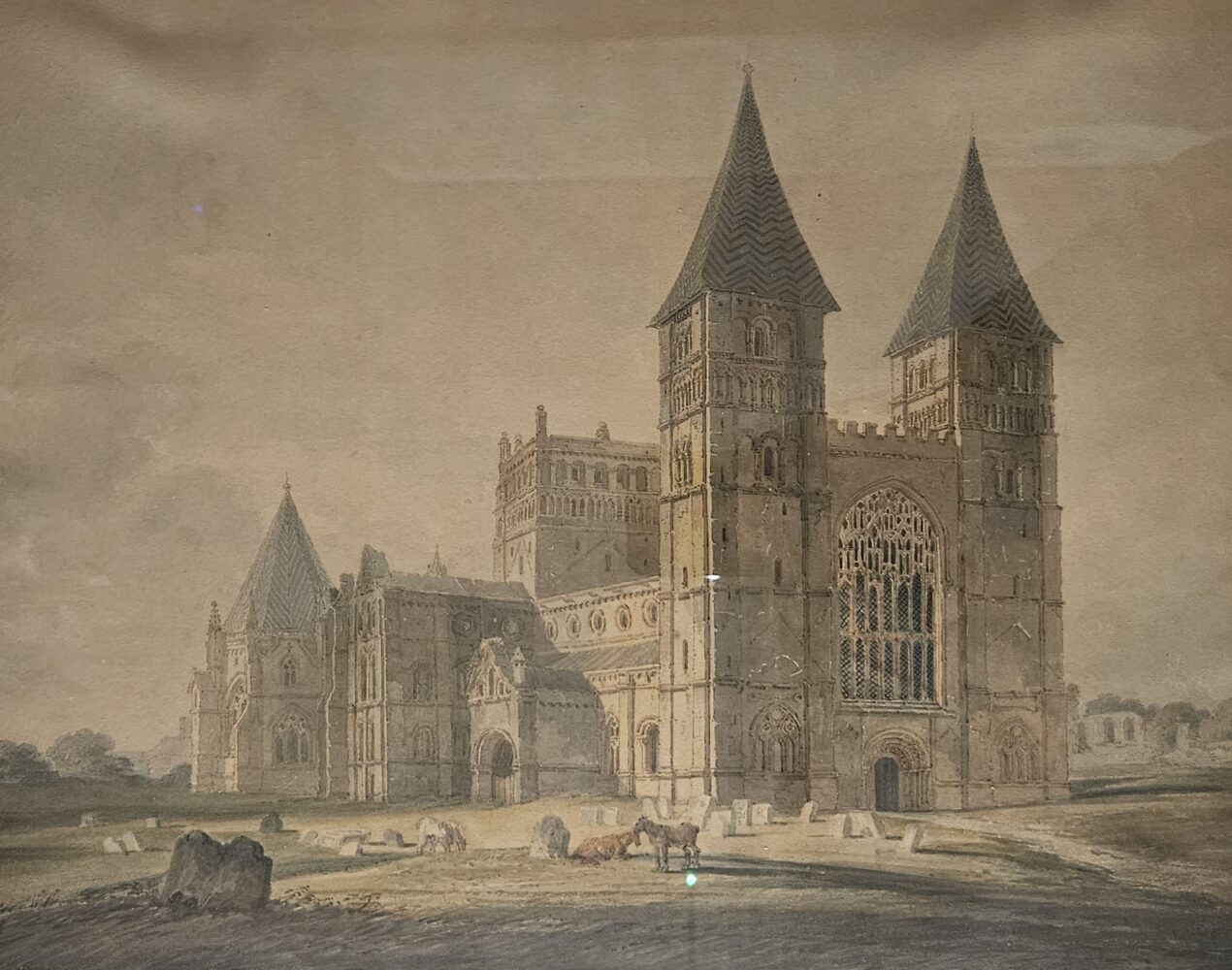
In a drawer tucked away in the corner of Special Collections is a very special hidden gem: a watercolour piece by J. M. W. Turner.
It depicts Southwell Minster in Nottinghamshire and is an excellent example of his earlier work, which is typified by his technical attention to detail as a trained draughtsman. He had already studied at the Royal Academy of Arts for a number of years at this point, accepted at just 14 years old into the prestigious institution. He developed this watercolour in 1794 from an initial sketch done at the scene.
Turner had a lifelong fascination with architecture and worked to design and build his own countryside villa about a decade after he finished the Southwell Minster painting.
Ben
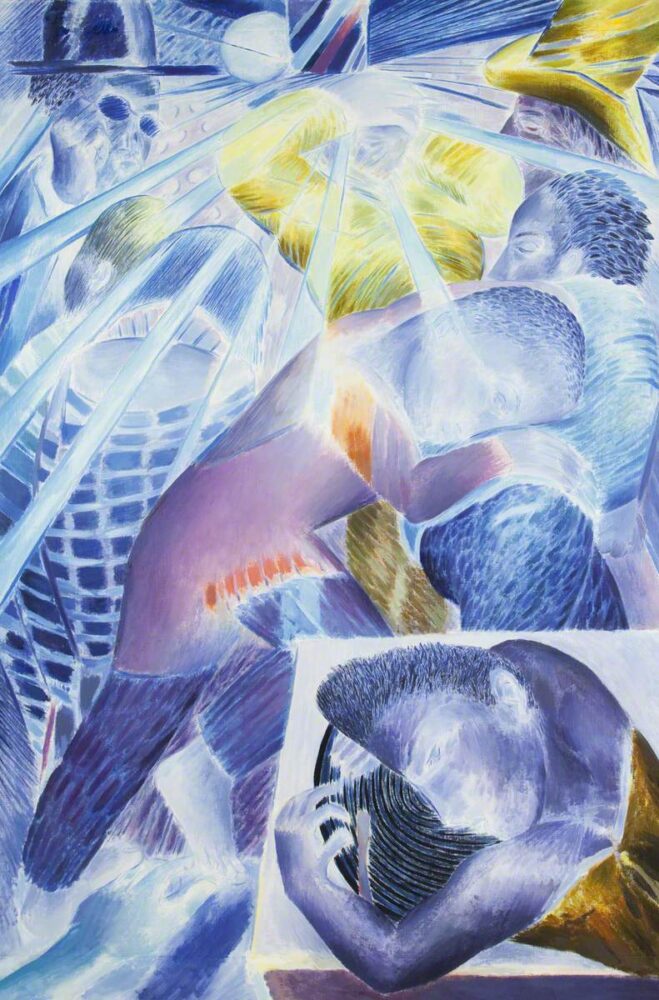
Object Number: Dub Scratchers by Denzil Forrester (b.1956)
This artwork caught my eye as soon as I started working at The Harris and is still one of my favourites, the vibrant colours give way to a scene of a Dancehall night in full swing.
Born in 1956 in Grenada and moving to the UK at 10 years old, Denzil Forrester’s work focuses on the duality of cultures centring between the Caribbean and the UK, focusing on Reggae, Dancehall and Dub sound system culture.
Depicted in an expressionist style utilising overlapping colours, figures and shapes, Denzil’s paintings capture the energy and spirit of Soundsystem nights. These are a fundamental part of sharing and celebrating Caribbean culture. His work weaves records, speaker boxes and racks of Soundsystem electronics with expressive colours, shapes and dancing in his paintings. Caribbean Soundsystem culture and music has influenced a lot of UK music including but not limited to Garage, Jungle, Drum and Bass, Grime and MCing.
Denzil’s work Dub Scratchers can be found on the first floor of The Harris.
At The Harris, our dedicated staff members are passionate about the treasures we care for. Each recommendation offers a glimpse into the connections our team has forged with the art, history, and culture housed within our walls.
Whether it’s an artwork that sparked inspiration or a cozy reading nook that invites reflection, our staff’s curated selections highlight the diverse experiences that make The Harris a true cultural hub.